
Indoor vs outdoor activities for kids is a question almost every parent asks — especially on a rainy Tuesday or a too-hot summer afternoon. The honest answer is simple: kids need both. Each type of play builds different skills. This guide breaks down what each one gives your child, adds activity ideas you can try today, and shows you an easy way to balance the two.
Benefits of Outdoor Activities for Kids
Outdoor time gives kids something indoor play can’t: space to move freely.
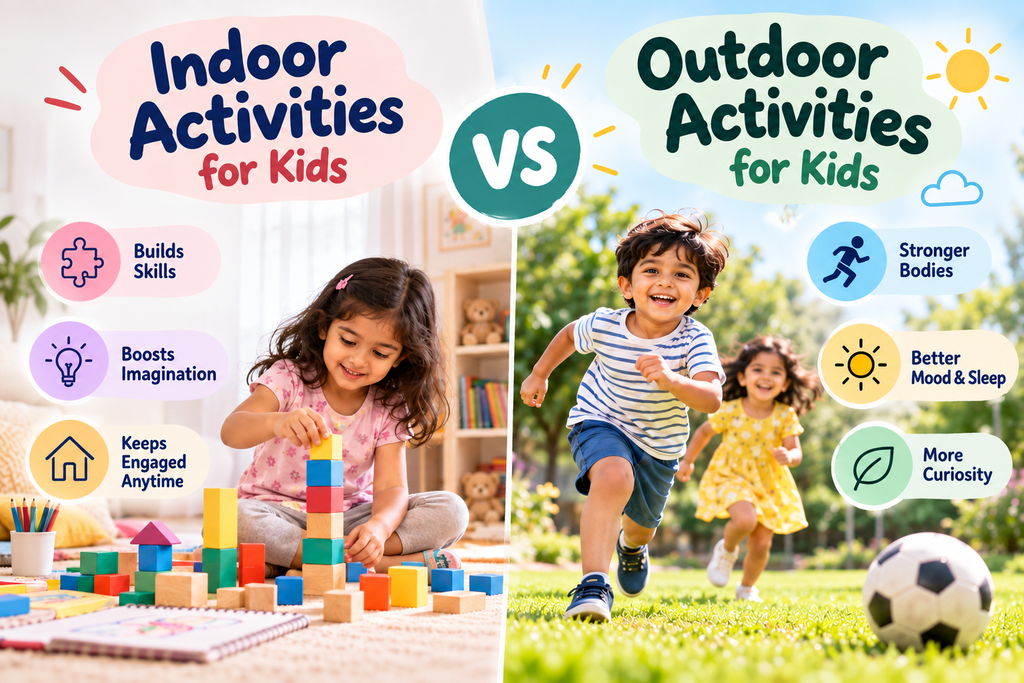
Stronger Bodies
Running, climbing, and jumping build strength and coordination. The CDC recommends daily physical activity for kids, and outdoor play is one of the easiest ways to hit that goal.
Better Mood and Sleep
Sunlight helps the body make vitamin D. It’s also linked to steadier mood and better sleep in kids.
More Confidence
Climbing a little higher or crossing a wobbly log teaches kids to judge risk safely. That builds real confidence, not just praise-based confidence.
More Curiosity
Bugs, weather, and changing seasons turn a backyard into a hands-on classroom. Kids ask more questions outside than they do at a desk.
Benefits of Indoor Activities for Kids
Indoor play isn’t just a rainy-day backup. It builds skills outdoor play doesn’t.
Fine Motor Skills
Puzzles, building blocks, and drawing strengthen small-muscle control. Kids need this for writing, buttoning clothes, and other daily tasks.
Focus and Calm
Quiet building, reading, and sorting games help kids slow down and concentrate — a different kind of focus than fast-moving outdoor games need.
Deeper Imagination
Dress-up, dolls, and building sets let kids build detailed stories at their own pace, often for longer stretches than outdoor games allow.
A Reliable Backup
Rain, extreme heat, or a sick day don’t have to mean no real play. Good indoor activities keep kids engaged no matter the weather.
A quick note: indoor play doesn’t have to mean screen time. Everything above is screen-free. If screens are part of your routine, the AAP’s screen time guidance is a helpful reference for age-appropriate limits.
Fun Activity Ideas to Try
These indoor vs outdoor activities give you an easy list to pull from any day of the week.
Outdoor
- Bike or scooter ride around the block
- Backyard scavenger hunt
- Sidewalk chalk art
- Water balloon toss
- Nature walk with a leaf or rock collection
- Simple obstacle course with cones or chalk lines
- Kite flying on a windy day
- Garden helper jobs — watering, digging, planting
Indoor
- Build a blanket fort
- Building-block challenge (tallest tower, longest bridge)
- Puzzle time, sized to their age
- Simple science experiment, like a baking soda volcano
- Arts and crafts with recycled materials
- Indoor scavenger hunt
- Board game or card game night
- Storytime, acting out the story together
Indoor vs. Outdoor Activities at a Glance
| Outdoor Play | Indoor Play | |
| Best for | Gross motor skills, energy release, nature exposure | Fine motor skills, focus, sustained imaginative play |
| Great examples | Bike riding, tag, nature walks, park visits | Building blocks, art projects, reading, puzzles |
| Limiting factor | Weather, daylight, safe space | Screen temptation, boredom without variety |
| Social style | Group games, shared space negotiation | One-on-one or solo focus |
How to Choose: Indoor or Outdoor?
Don’t think of it as picking a winner. Use these simple checks instead:
- Weather and time of day — check this first, before planning around one mode.
- Energy level — a wound-up kid usually needs to burn energy outside before an indoor activity can hold their attention.
- Who else is involved — group play with siblings often works better outdoors. One-on-one bonding often works better indoors, with a shared project.
By Age
- Toddlers (1–3): Short bursts of both — a bit of yard time, then indoor sensory play.
- School-age (6–12): Longer outdoor games, plus indoor projects like building sets or craft kits.
- Tweens: Less structured outdoor “hangout” time, plus more independent indoor hobbies.
A Simple Weekly Rhythm to Try
You don’t need a rigid schedule, but a loose daily rhythm helps avoid the “we’ve been inside all day” scramble at 5 p.m.:
- Morning: Outdoor movement — even 20 minutes of yard time, a walk, or scooter riding.
- Midday: Indoor quiet or creative time — puzzles, drawing, reading, or building.
- Afternoon: Outdoor free play — park, bike ride, or backyard games.
- Evening: Indoor wind-down — books, quiet games, or a low-key craft before bed.
Across a week, rotate in variety rather than repeating the same activity daily: one nature walk, one indoor craft project, one active outdoor game day, and one rainy-day backup plan ready to go.
Tips for Parents
- Let mood and weather guide the day, not a rigid plan.
- Keep an “indoor activity bin” stocked with craft supplies so a rainy day doesn’t default to screens.
- Rotate outdoor gear and games every few weeks to keep the yard or park feeling fresh.
- Give kids some choice — letting them pick between two options increases how engaged they’ll be.
- Zoom out to the week, not the day — the balance over time is what matters.
FAQ’S
Outdoor play focuses on big movement, like running and climbing. Indoor play focuses on small movement and focus, like building and drawing. Kids need both.
Most guidelines suggest at least 60 minutes of active play a day for school-age kids, in short bursts or all at once. Younger kids benefit from several shorter outdoor sessions spread across the day.
Building blocks, puzzles, drawing, indoor scavenger hunts, and pretend-play sets all work well. Keep a stocked activity bin ready so rainy days don’t default to screen time
