
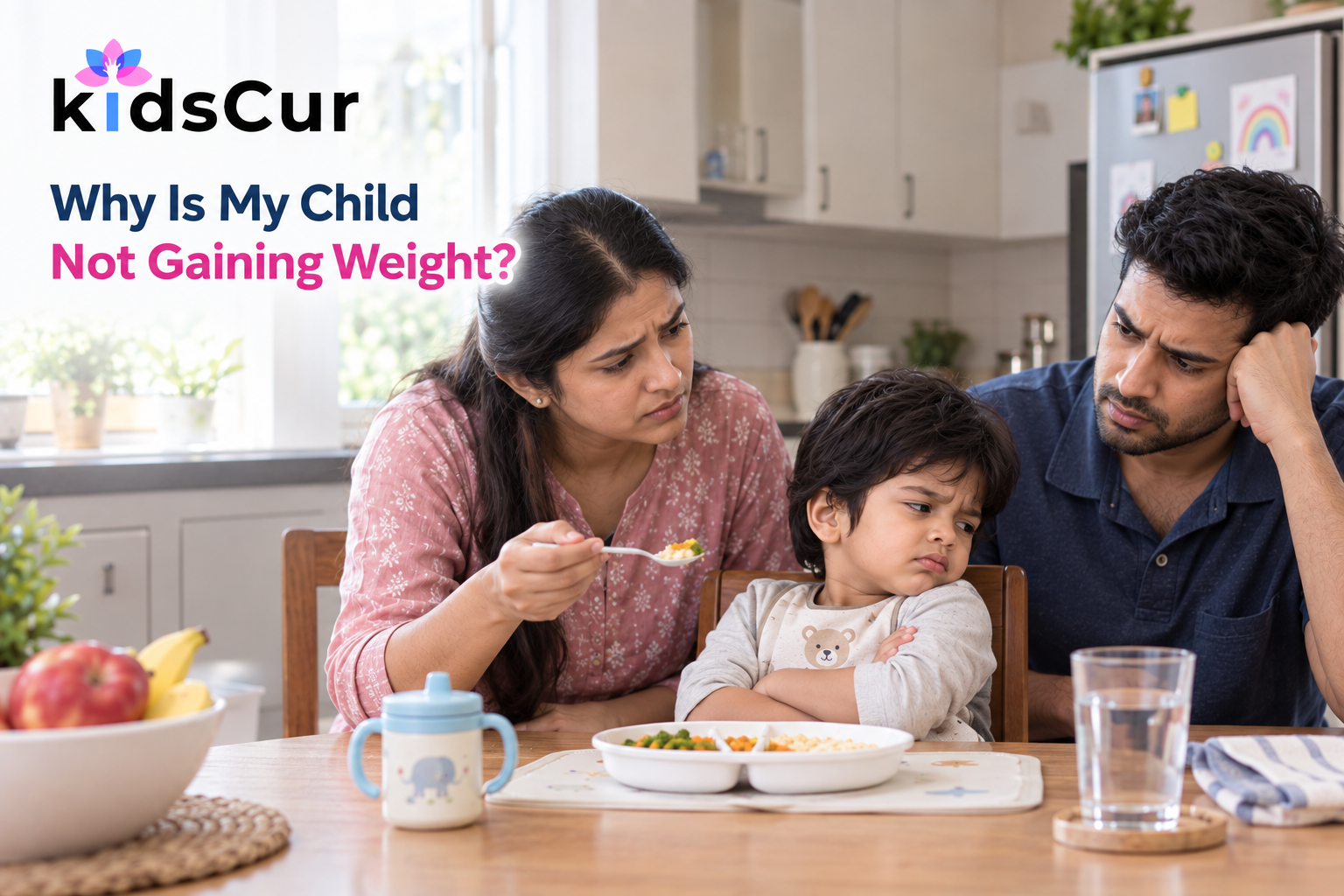
A child not gaining weight is usually taking in too few calories, not absorbing what they eat, or burning more energy than they get. In Indian homes, the common triggers are picky eating, repeated infections, stomach worms and iron deficiency. Most cases improve with simple changes at home. But if your baby shows no weight gain for two to three months, or your older child keeps slipping on the growth chart, see a paediatrician.
Seeing your child not gaining weight can make any parent anxious, especially when relatives comment that your little one looks thin. Growth is not a race. This guide explains what is normal and what you can safely do at home.
Child Not Gaining Weight: What Is Normal and What Is Not?
Doctors do not judge weight by one number. They plot your child’s weight on a growth chart and watch the curve over time. Children up to five years follow the WHO growth standards, and children aged five to eighteen follow the IAP 2015 charts made for Indian kids.
A steady curve is a good sign, even if your child is on a lower percentile. Doctors worry when they see:
- Weight staying flat for several months
- Weight dropping across two major percentile lines
- Weight lagging far behind height
A cold, teething or a busy festival week can cause a small dip that corrects itself. Learn more in our guide on how to read your child’s growth chart.
[Insert second image here: simple growth chart graphic, alt text: Growth chart showing normal weight gain in Indian children]
Slow but Healthy Growth vs a Child Not Gaining Weight
Two children can look equally thin and still be in very different situations. These examples are illustrative, not real patients.
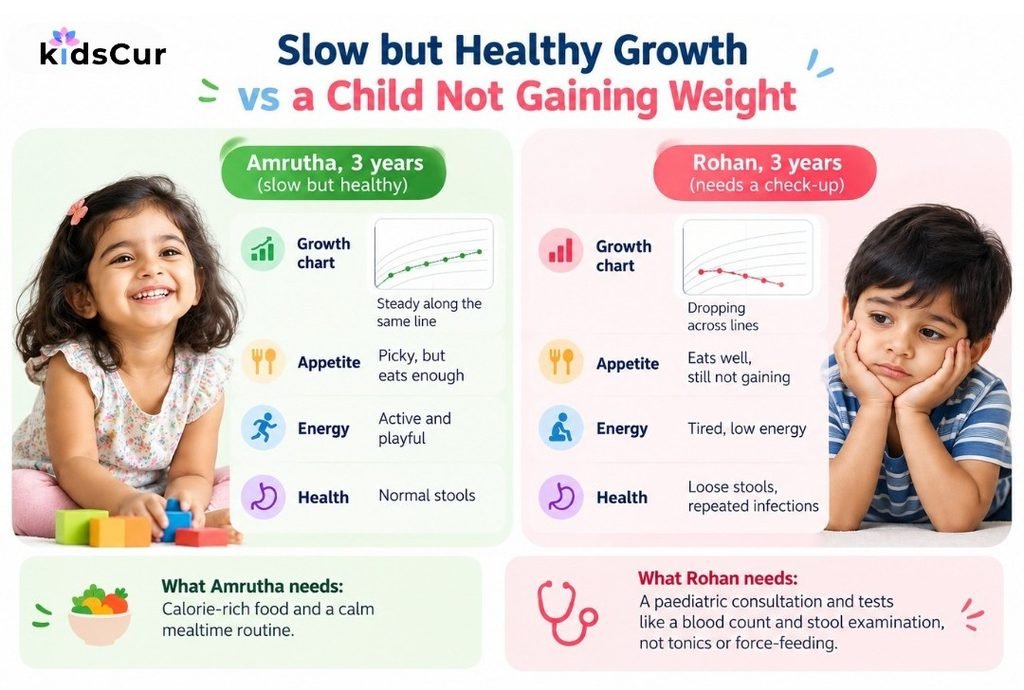
| Factor | Amrutha , 3 years (slow but healthy) | Rohan, 3 years (needs a check-up) |
|---|---|---|
| Growth chart | Steady along the same line | Dropping across lines |
| Appetite | Picky, but eats enough | Eats well, still not gaining |
| Energy | Active and playful | Tired, low energy |
| Health | Normal stools | Loose stools, repeated infections |
Amrutha needs calorie-rich food and a calm mealtime routine. Rohan is a child not gaining weight despite good eating, so he needs a paediatric consultation and tests like a blood count and stool examination, not tonics or force-feeding.
Common Reasons Behind a Child Not Gaining Weight
The most common cause is simply too few calories going in. Children may fill up on milk, juice or biscuits, or graze all day and never feel truly hungry at mealtimes. If meals are a daily fight, our tips on handling picky eaters can help.
Other frequent causes include:
- Repeated infections: loose motions, colds and urinary infections burn calories and reduce appetite.
- Intestinal worms: they steal nutrients and are common in Indian children.
- Iron-deficiency anaemia: the Indian Academy of Pediatrics links it to worm infestation and poor growth. See our article on iron deficiency in children.
- Absorption problems: lactose intolerance, celiac disease, chronic diarrhoea or reflux.
- Medical or emotional causes: thyroid problems, heart conditions, or stress from a new school or sibling.
My Child Eats Well but Weight Stays Low. Why?
This is one of the most common worries parents bring to us. If a child not gaining weight seems to eat plenty, check the real intake first. Write down everything your child eats and drinks for three days, including sips of milk. Many parents find it is lower than they assumed.
If intake is truly good, the doctor may suggest a blood count, stool test, thyroid test or celiac screening. Please avoid starting tonics or protein powders on your own, as they can hide the real problem.
Easy Indian Foods to Help Your Child Put On Weight
The goal is to add calories without turning mealtime into a battle. Offer three meals and two or three small snacks at fixed times, and skip constant grazing in between. Then make every spoon count:
- A teaspoon of ghee in dal-rice or khichdi
- Mashed banana or dry-fruit powder in porridge
- Ragi malt cooked in full-fat milk
- Paneer, egg bhurji and full-fat curd
- Peanut or til chikki as a snack
For more ideas, see our list of healthy weight gain foods for kids.
How you feed matters too. Seat your child at the table without TV or a phone, serve small portions and let them ask for more. Chasing or bribing usually backfires. A child not gaining weight needs patient, steady nutrition, not a shortcut. Ask your paediatrician about deworming, iron and vitamin D.
When to See a Doctor for a Child Not Gaining Weight
Book a visit if you notice any of these, in line with the IAP growth monitoring guidelines:
- A baby under six months gains nothing in a month
- A baby of six to twelve months shows no gain for two to three months
- Your child drops across two major lines on the growth chart
- Repeated vomiting, loose stools lasting over a week, or blood in the stool
- Extreme tiredness, frequent fevers or delayed milestones
Carry the growth records, vaccination card and food diary to the appointment. Once the cause is treated, most children catch up, though recovery can take several months. You can also book a paediatric consultation with KidsCure.
Frequently Asked Questions
How much weight should a child gain each year?
After infancy, most children gain roughly 2 to 3 kg a year until puberty. This varies with age, genes and growth spurts, so the trend on the growth chart matters more than the exact number.
Can worms slow a child’s weight gain?
Yes. Worms steal nutrients, reduce appetite and can cause anaemia, all of which slow weight gain. Your paediatrician can advise on safe deworming.
Are health drinks or protein powders safe for kids?
Not without medical advice. Many are high in sugar and reduce appetite for real meals. Home-cooked, energy-rich food is the safest first step.
Disclaimer: This article is for general information and does not replace medical advice. Please consult a qualified paediatrician about your child’s health.
